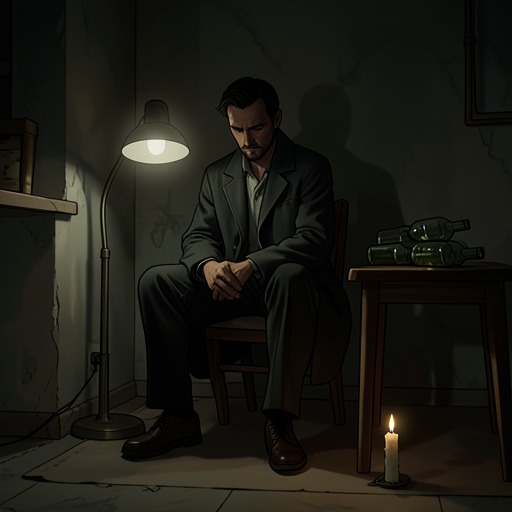
Justifying murder through utilitarian calculation
Crime and PunishmentJustifying murder through utilitarian calculation turns a proposed killing into an apparent balance sheet: one life is weighed against the lives and social prospects that the victim’s money might improve. In a tavern conversation, an unnamed student argues that killing Alyona Ivanovna could be justified if her wealth were redirected toward people in need. The reasoning does not settle the moral question; its force in the narrative comes from the way it makes violence sound like a public service, then tests that abstraction against the speaker’s own unwillingness to act.
The Argument as a Moral Calculation
The student first presents Alyona as not merely useless but actively harmful. He describes her as old, ill, spiteful, and close to death, and argues that her money will otherwise be buried in a monastery. Against this, he sets young people deprived of help and families facing destitution, ruin, and vice. The proposed killing becomes, in his account, a means of financing good works: the money could help many people find a better direction and rescue families from poverty. His case depends on treating Alyona’s life and the possible benefits to others as quantities that can be compared.
The student strengthens that calculation by diminishing the value of Alyona’s life. He portrays her as a source of harm to others and invokes her recent spite toward Lizaveta Ivanovna as an example. This characterization is part of his argument, not an independent judgment established by the narration. By reducing Alyona to the damage she supposedly causes, and by imagining the many lives her money might improve, he makes the proposed murder appear to be an exchange with a positive balance. The apparent precision of the exchange conceals its uncertain premises: the good deeds are anticipated, while the killing itself is immediate and irreversible.
The argument also appeals to a wider social failure. The student points to young lives going unsupported and families being driven toward deprivation and vice; the old woman’s money, he insists, could counter those conditions. The appeal gives the proposal a humanitarian purpose, but it also treats the victim as an instrument for that purpose. Its logic asks whether a single crime can be erased by many beneficial consequences, rather than whether a person may be deliberately killed to produce them.
The Challenge of Personal Responsibility
The officer initially grants part of the student’s premise, saying that the old woman does not deserve to live, but adds that nature must be allowed to take its course. The student rejects that limit. He argues that nature must be corrected and questions what people mean when they invoke duty and conscience. In his account, the moral rules against such an act risk becoming prejudice that prevents consequential action, including the actions of great men. The exchange therefore sets the anticipated social benefit against the claims of conscience and the restraint imposed by ordinary moral rules.
The conversation’s decisive test is personal. The student asks the officer whether he would kill Alyona himself. The officer answers that he would not and insists that he had only been arguing the justice of the act, not volunteering to perform it. The officer then turns that distinction back on him: if the deed is not just enough for the speaker to undertake, its justice is doubtful. This response exposes the distance between making a theoretical case and bearing responsibility for its consequences. The student’s reasoning can condemn hesitation in the abstract, but it does not overcome his own refusal to act.
That refusal does not undo the argument’s influence; it reveals its limits. The exchange leaves the proposed calculation suspended between an abstract defense and a concrete deed. The supposed beneficiaries remain hypothetical, while the act required to obtain the money is specific. The student can assign value to other people’s lives and invoke humanity as a purpose, yet the conversation offers no practical assurance that the promised good would follow. Its challenge is not simply whether the arithmetic adds up, but who is willing to make the calculation real and accept what it requires.
Raskolnikov’s Reception of the Debate
Rodion Romanovitch Raskolnikov hears the discussion and is violently agitated. The narration stresses that the ideas are not unprecedented: they resemble ordinary youthful talk that he has encountered in other forms and on other subjects. What unsettles him is their timing. His own mind has already begun to conceive a similar idea, and he has recently brought away what the narration calls its embryo from his visit concerning Alyona. The tavern conversation seems to meet his private reasoning at the moment it is forming.
Raskolnikov experiences the coincidence as strange and later regards the trivial conversation as having had an immense influence on his action. He interprets it as though it carried something preordained, a guiding hint. This is his perception of the encounter, not proof that an outside force directs him. The scene instead shows how a public argument can appear to confirm a private idea: the student’s reasoning gives verbal shape to a justification Raskolnikov recognizes, while the coincidence acquires significance through his own state of mind.
The contrast between the student and Raskolnikov sharpens the scene’s effect. The student offers the argument and then disclaims any intention of carrying it out; Raskolnikov hears the same kind of reasoning while his own contemplated act is moving toward a practical test. The conversation consequently serves not as a plan supplied to him in full, but as a disturbing echo that makes his idea seem less isolated and, to him, almost sanctioned. Its influence is real within the narrative even though the speaker himself refuses the deed.
Calculation, Crime, and Self-Exculpation
The later account of Raskolnikov’s thinking extends the concept from a general social argument to a theory of criminal action. He has long wondered why crimes are so often badly concealed and why criminals leave obvious traces. He concludes that the central difficulty lies not only in material obstacles but in the criminal, whose will and reasoning may fail at the moment when caution matters most. He imagines this failure as a kind of illness that develops before the crime, persists during it and for some time afterward, and then passes away. He remains unable to decide whether this condition causes crime or whether crime itself brings on something like illness.
Raskolnikov applies a different assumption to himself. He decides that his own design will not produce this failure of reason or will because, in his classification, the design is not a crime. He expects that maintaining his mental powers will let him overcome the practical difficulties, which he considers secondary; yet the detailed preparation he imagines has not begun, and his own final decisions are what he trusts least. The narrative makes the tension plain: he theorizes that criminals lose control, then exempts himself by redefining his planned act before it occurs.
Together, the tavern debate and Raskolnikov’s theory show how the calculation can function as more than a defense of social utility. It can also help separate the thinker from the moral category of criminal: the act is recast as a justified exception, while its likely consequences and the actor’s vulnerability are treated as problems that reason can manage. The student’s refusal to act exposes the weakness of a justice that remains theoretical; Raskolnikov’s self-exemption reveals the further danger of believing that a carefully reasoned exception will leave the person who commits it unchanged.